Your questions, our answers
Madagascar travel FAQ
This Madagascar travel FAQ answers the questions our travelers ask most, from visas to the best season, straight from our local team in Antananarivo, the capital.
Planning your trip Destinations and Wildlife Getting to and around Madagascar Where to stay Prices and payment Travel practicalities Culture and etiquette Safety and health When to go
Before you book
Planning your trip
We recommend planning a few months in advance, especially for travel between June and October, the busiest season, when the best lodges fill up first. Last-minute trips are sometimes possible, so ask us.
Madagascar is the fourth largest island in the world, and long distances and slow roads mean travel time adds up quickly on such a big island. Plan at least 11 to 13 days to explore one region properly. With three weeks, you can combine two regions or explore the remote west.
It depends on what you want to see. For wildlife, The Treasures of the East (11 days) and Exploring the RN7 Route (13 days) take you to the best parks for lemurs. For a mix of nature, culture and adventure, Natural Wonders of Madagascar (11 days) goes from the rainforest to the Tsingy de Bemaraha. For luxury travelers and keen birders, our two 18-day luxury tours use private charter flights. All of them can be adapted as a private, custom tour. See all our Madagascar tours.
Yes. As a local tour operator, we adapt every tour to your travel plans, interests, budget and comfort level, or build your itinerary from scratch.
All our tours are private: your own vehicle and guide, for you and your travel companions only. Depending on the tour, they welcome from 1 traveler on The Treasures of the East, up to 16 on Natural Wonders of Madagascar and up to 32 on Exploring the RN7 Route, so they also suit families and groups of friends.
Yes. The Treasures of the East, Exploring the RN7 Route and Natural Wonders of Madagascar are suitable for all ages, and we adapt the pace and the activities to children.
Where to go
Destinations and wildlife
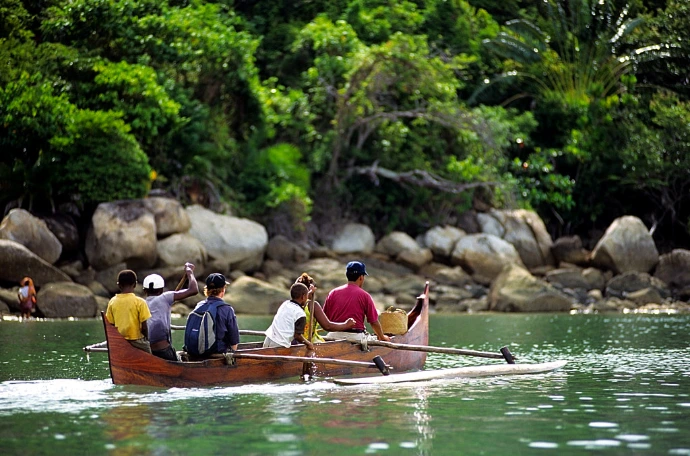
The country is huge and every region feels different. The main destinations on our itineraries are:
- The east: the dense rainforest of Andasibe-Mantadia National Park and the east coast, with Île Sainte-Marie, the former pirate island also called Nosy Boraha.
- The highlands and the south: rice terraces, Ranomafana, the natural pools of Isalo National Park and the beaches of Ifaty, along the RN7.
- Western Madagascar: the Tsiribihina River, the limestone tsingy formations of the Tsingy de Bemaraha and the Avenue of the Baobabs.
- The north: Nosy Be, Nosy Komba and Nosy Tanikely, with some of the most beautiful beaches of the Indian Ocean, plus Ankarana and Amber Mountain.
- The deep south: the spiny forest of Berenty and the coast around Fort Dauphin.
Madagascar’s wildlife is like nowhere else in the world: more than 80% of its species are endemic. You’ll see lemurs, from the tiny mouse lemur to the indri, the largest lemur, as well as chameleons, reptiles, frogs and endemic birds. The best place to start is Andasibe-Mantadia National Park, a few hours from Antananarivo, where night walks reveal many animals you won’t see by day.
Flights and roads
Getting to and around Madagascar
International flights arrive at Ivato International Airport in Antananarivo. From South Africa, there are direct flights from Johannesburg. From the UK, Ireland and the rest of Europe, most travelers connect through Paris (with Air France), Addis Ababa or Nairobi. From North America, Australia and New Zealand, there are no direct flights: count on one or two connections, often via Paris, Johannesburg, Addis Ababa, Nairobi or Mauritius, and a full day of travel or more. We meet you on arrival and take care of your transfer.
Mostly by road, in a private 4x4 with your driver-guide. Road travel is slow: average speeds are often around 50 km/h, so a few hours’ drive on the map can take most of a day. Taxi-brousse minibuses are the budget option, but they are uncomfortable for long distances. Because of the island’s size, domestic flights are often the best way to link regions on longer itineraries, and some trips include boat transfers.
Lodges and hotels
Where to stay
Accommodations range from charming hotels in Antananarivo and forest lodges near the wildlife trails of Andasibe to eco lodges near the parks and beach hotels on the coast. On our luxury tours, you stay in boutique resorts and luxury eco-lodges with air-conditioning and gourmet dining. In remote areas, hotels can be simpler, and power outages or an irregular water supply are not unusual.
Budget
Prices and payment
It depends on the length of the trip, the season, the number of travelers, domestic flights and the level of accommodation. Request a quote for a detailed, transparent price with no commitment.
Every quote lists exactly what is included, so you know what to expect before you book. As a rule, our tours include your welcome at the airport and transfers, a private vehicle with your driver-guide, your accommodation, and the visits and activities described in your itinerary. Depending on the tour, domestic or private charter flights and boat transfers are also included. International flights, visa fees, travel insurance and personal expenses are not included.
Payment terms are detailed in your quote and confirmed with you before you book, so you know exactly when and how to pay.
Our cancellation conditions are set out in your quote and confirmed before booking. We also recommend travel insurance that covers trip cancellation.
Tipping is customary in Madagascar’s tourism industry but always at your discretion. Many travelers tip their guide and their local park guides at the end of the trip.
Good to know
Travel practicalities
Most visitors need a tourist visa to enter Madagascar, including travelers from the UK, Ireland, the US, Canada, Australia and New Zealand. Requirements vary by nationality, so South African and other travelers should check the rules for their passport. You can get it on arrival at Ivato airport or online through the official e-visa website, for stays of up to 90 days. If you get it on arrival, have cash ready to pay the visa fee in euros or US dollars. Your passport must be valid for at least six months after your return date, with blank pages for the visa. Rules can change, so check the official website before you travel.
No vaccination is mandatory unless you arrive from a yellow fever zone. Malaria prevention is recommended, especially on the coast, along with insect repellent. Talk to a travel health clinic a few weeks before departure.
Yes, we strongly recommend it. Choose a policy that covers medical expenses, emergency assistance and medical evacuation, as well as trip cancellation.
The local currency is the Malagasy ariary, and some locals still quote prices in the old Malagasy franc. Euros and US dollars are the easiest money to exchange. ATMs are available in major towns, but carry cash for rural areas and remote areas, where cards are rarely accepted.
A local SIM card is easy to buy on arrival and gives you mobile data in most towns. Many hotels offer Wi-Fi, but coverage is limited in remote areas and national parks.
No. Drink only bottled water throughout your trip. We keep a supply in the vehicle.
Malagasy and French are the main languages. English is less common outside tourist areas, which is why we provide English-speaking guides on request.
Light clothing for the coast, a warm layer for the highlands, where nights can be cool, rain gear, good walking shoes, a headlamp for night walks, insect repellent and sun protection. Our team will share more tips before you leave.
Local life
Culture and etiquette
Yes. Malagasy people generally welcome visitors with warmth and curiosity, especially in rural areas. A few words of Malagasy or French and respect for local customs go a long way, and your guide will help you with both.
- Do greet people: “Manao ahoana” means hello in Malagasy.
- Do respect local traditions and taboos, called fady. Your guide will explain them.
- Do ask before taking photos of people.
- Do dress modestly in villages and sacred places.
- Don’t point at or sit near tombs, which are sacred in Malagasy life and culture.
- Don’t touch or feed lemurs or other wildlife.
- Don’t drink tap water or plan to drive at night.
Peace of mind
Safety and health
Most trips go smoothly, and traveling with a local guide is one of the best ways to stay safe: we never drive at night, our driver-guides are trained in first aid and our team is reachable 24/7. The situation can change, and the risk level varies by region, so check your government’s latest travel advice before you go, such as the UK Foreign Office, the US State Department, Smartraveller (Australia) or the Government of Canada.
Medical care is limited outside major cities such as Antananarivo. That’s why we recommend travel insurance with medical evacuation, and why our driver-guides are trained in first aid by the Red Cross.
Most park walks are easy to moderate, while some hikes, like the canyon trails of Isalo National Park or the Tsingy de Bemaraha, involve climbing and narrow passages. Tell us your fitness level and we’ll adapt the itinerary to a slower pace if needed.
Yes. A licensed local guide is required in national parks. Your guide comes with you and translates whenever needed, and your park fees support conservation, responsible tourism and the local people who live around the parks.
Seasons
When to go
April to November, during the dry season. From May to October, the weather is mild, with daytime temperatures often around 20–25°C (68–77°F) in the highlands. Exploring the RN7 Route and our luxury tours run year round, while Natural Wonders of Madagascar runs from March to October. From December to March, the rainy season brings heavy rain and a risk of cyclones, especially on the east coast, and some roads become difficult.
Humpback whales pass along the east coast, especially off Île Sainte-Marie (Nosy Boraha), from July to September. Our tour The Treasures of the East includes a stay on the island.
Lemurs can be seen all year. September to November is a favorite, as many species have young, and night walks reveal mouse lemurs at any time of year.
Still have questions?
Our team is happy to help with your journey, whether you’re just starting to plan or ready to book. Contact us or request a custom quote.